Category: Uncategorized

  • Unique and Nonunique Indexes

    Indexes can be unique or nonunique. Unique indexes guarantee that no two rows of a table have duplicate values in the key column or columns.

    oracle java training courses malaysia

    For example, your application may require that no two employees have the same employee ID. In a unique index, one rowid exists for each data value. The data in the leaf blocks is sorted only by key.

    java programming training courses malaysia

    Nonunique indexes permit duplicates values in the indexed column or columns. For example, the first_name column of the employees table may contain multiple Mike values. For a nonunique index, the rowid is included in the key in sorted order, so nonunique indexes are sorted by the index key and rowid (ascending).

    dynamics 365 marketing training courses malaysia

    Oracle Database does not index table rows in which all key columns are null, except for bitmap indexes or when the cluster key column value is null.

    java ee enterprise edition training courses malaysia

  • Composite Indexes

    A composite index, also called a concatenated index, is an index on multiple columns in a table.

    Place columns in a composite index in the order that makes the most sense for the queries that will retrieve data. The columns need not be adjacent in the table.

    kubernetes training courses malaysia

    Composite indexes can speed retrieval of data for SELECT statements in which the WHERE clause references all or the leading portion of the columns in the composite index. Therefore, the order of the columns used in the definition is important. In general, the most commonly accessed columns go first.

    juniper networks training courses malaysia

    For example, suppose an application frequently queries the last_name, job_id, and salary columns in the employees table. Also assume that last_name has high cardinality, which means that the number of distinct values is large compared to the number of table rows. You create an index with the following column order:

    CopyCREATE INDEX employees_ix
       ON employees (last_name, job_id, salary);
    

    Queries that access all three columns, only the last_name column, or only the last_name and job_id columns use this index. In this example, queries that do not access the last_name column do not use the index.

    jboss training courses malaysia

    Note

    In some cases, such as when the leading column has very low cardinality, the database may use a skip scan of this index (see “Index Skip Scan”).

    Multiple indexes can exist on the same table with the same column order when they meet any of the following conditions:

    • The indexes are of different types.For example, you can create bitmap and B-tree indexes on the same columns.
    • The indexes use different partitioning schemes.For example, you can create indexes that are locally partitioned and indexes that are globally partitioned.
    • The indexes have different uniqueness properties.For example, you can create both a unique and a non-unique index on the same set of columns.

    For example, a nonpartitioned index, global partitioned index, and locally partitioned index can exist for the same table columns in the same order. Only one index with the same number of columns in the same order can be visible at any one time.

    jboss enterprise application platform training courses malaysia

    This capability enables you to migrate applications without the need to drop an existing index and re-create it with different attributes. Also, this capability is useful in an OLTP database when an index key keeps increasing, causing the database to insert new entries into the same set of index blocks. To alleviate such “hot spots,” you could evolve the index from a nonpartitioned index into a global partitioned index.

    If indexes on the same set of columns do not differ in type or partitioning scheme, then these indexes must use different column permutations. For example, the following SQL statements specify valid column permutations:

    CopyCREATE INDEX employee_idx1 ON employees (last_name, job_id);
    CREATE INDEX employee_idx2 ON employees (job_id, last_name);
  • Keys and Columns

    A key is a set of columns or expressions on which you can build an index.

    kubernetes containarization training courses malaysia

    Although the terms are often used interchangeably, indexes and keys are different. Indexes are structures stored in the database that users manage using SQL statements. Keys are strictly a logical concept.

    cloud computing training courses malaysia

    The following statement creates an index on the customer_id column of the sample table oe.orders:

    CopyCREATE INDEX ord_customer_ix ON orders (customer_id);
    

    In the preceding statement, the customer_id column is the index key. The index itself is named ord_customer_ix.

    Note

    Primary and unique keys automatically have indexes, but you might want to create an index on a foreign key.

    ai artificial intelligence training courses malaysia

    See also

    • “Data Integrity”
    • Oracle Database SQL Language Reference CREATE INDEX syntax and semantics

    lean it certification training courses malaysia

  • Index Usability and Visibility

    Indexes are usable (default) or unusable, visible (default) or invisible.

    microsoft certification malaysia

    These properties are defined as follows:

    • UsabilityAn unusable index, which is ignored by the optimizer, is not maintained by DML operations. An unusable index can improve the performance of bulk loads. Instead of dropping an index and later re-creating it, you can make the index unusable and then rebuild it. Unusable indexes and index partitions do not consume space. When you make a usable index unusable, the database drops its index segment.
      juniper certification malaysia
    • VisibilityAn invisible index is maintained by DML operations, but is not used by default by the optimizer. Making an index invisible is an alternative to making it unusable or dropping it. Invisible indexes are especially useful for testing the removal of an index before dropping it or using indexes temporarily without affecting the overall application.
      istqb certification malaysia

    See also

    “Overview of the Optimizer” to learn about how the optimizer select execution plans

    database training courses malaysia

  • Benefits of Indexes

    The absence or presence of an index does not require a change in the wording of any SQL statement.

    An index is a fast access path to a single row of data. It affects only the speed of execution. Given a data value that has been indexed, the index points directly to the location of the rows containing that value.

    veeam certification malaysia

    When an index exists on one or more columns of a table, the database can in some cases retrieve a small set of randomly distributed rows from the table. Indexes are one of many means of reducing disk I/O. If a heap-organized table has no indexes, then the database must perform a full table scan to find a value. For example, a query of location 2700 in the unindexed hr.departments table requires the database to search every row in every block. This approach does not scale well as data volumes increase.

    red hat certification malaysia

    In general, consider creating an index on a column in any of the following situations:

    • The indexed columns are queried frequently and return a small percentage of the total number of rows in the table.
      oracle certification malaysia
    • A referential integrity constraint exists on the indexed column or columns. The index is a means to avoid a full table lock that would otherwise be required if you update the parent table primary key, merge into the parent table, or delete from the parent table.
    • A unique key constraint will be placed on the table and you want to manually specify the index and all index options.

    nutanix certification malaysia

  • Indexes and Index-Organized Tables

    Indexes are schema objects that can speed access to table rows. Index-organized tables are tables stored in an index structure.

    This chapter contains the following sections:

    • Introduction to Indexes
    • Overview of B-Tree Indexes
    • Overview of Bitmap Indexes
    • Overview of Function-Based Indexes
    • Overview of Application Domain Indexes
    • Overview of Index-Organized Tables

    red hat linux administration training courses malaysia

    Introduction to Indexes

    An index is an optional structure, associated with a table or table cluster, that can sometimes speed data access.

    red hat enterprise linux rhel training courses malaysia

    Indexes are schema objects that are logically and physically independent of the data in the objects with which they are associated. Thus, you can drop or create an index without physically affecting the indexed table.

    red hat certified specialist in server hardening malaysia

    Note

    If you drop an index, then applications still work. However, access of previously indexed data can be slower.

    For an analogy, suppose an HR manager has a shelf of cardboard boxes. Folders containing employee information are inserted randomly in the boxes. The folder for employee Whalen (ID 200) is 10 folders up from the bottom of box 1, whereas the folder for King (ID 100) is at the bottom of box 3. To locate a folder, the manager looks at every folder in box 1 from bottom to top, and then moves from box to box until the folder is found. To speed access, the manager could create an index that sequentially lists every employee ID with its folder location:

    CopyID 100: Box 3, position 1 (bottom)
    ID 101: Box 7, position 8 
    ID 200: Box 1, position 10
    .
    .
    .
    

    Similarly, the manager could create separate indexes for employee last names, department IDs, and so on.

    This section contains the following topics:

    • Benefits of Indexes
    • Index Usability and Visibility
    • Keys and Columns
    • Composite Indexes
    • Unique and Nonunique Indexes
    • Types of Indexes
    • How the Database Maintains Indexes
    • Index Storage

    red hat certified specialist in linux performance tuning malaysia

  • Overview of Object Tables

    An Oracle object type is a user-defined type with a name, attributes, and methods. An object table is a special kind of table in which each row represents an object. Object types make it possible to model real-world entities such as customers and purchase orders as objects in the database.

    sap erp pp production planning training courses malaysia

    An object type defines a logical structure, but does not create storage. The following example creates an object type named department_typ:

    CopyCREATE TYPE department_typ AS OBJECT
       ( d_name     VARCHAR2(100),
         d_address  VARCHAR2(200) );
    /
    

    The following example creates an object table named departments_obj_t of the object type department_typ, and then inserts a row into the table. The attributes (columns) of the departments_obj_t table are derived from the definition of the object type.

    sap erp procurement material management training courses malaysia

    CopyCREATE TABLE departments_obj_t OF department_typ;
    INSERT INTO departments_obj_t 
      VALUES ('hr', '10 Main St, Sometown, CA');
    

    Like a relational column, an object table can contain rows of just one kind of thing, namely, object instances of the same declared type as the table. By default, every row object in an object table has an associated logical object identifier (OID) that uniquely identifies it in an object table. The OID column of an object table is a hidden column.

    red hat openstack training courses malaysia

    See also

    • Oracle Database Object-Relational Developer’s Guide to learn about object-relational features in Oracle Database
    • Oracle Database SQL Language Reference for CREATE TYPE syntax and semantics

    red hat linux certification malaysia

  • External Table Creation

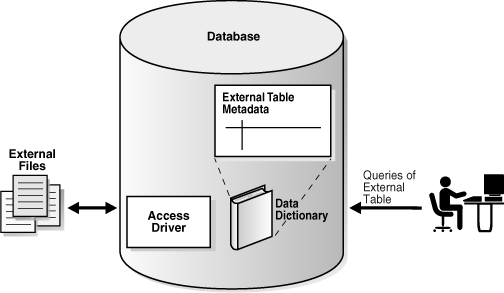
    Internally, creating an external table means creating metadata in the data dictionary. Unlike an ordinary table, an external table does not describe data stored in the database, nor does it describe how data is stored externally. Rather, external table metadata describes how the external table layer must present data to the database.

    sap wm warehouse management training courses malaysia

    A CREATE TABLE ... ORGANIZATION EXTERNAL statement has two parts. The external table definition describes the column types. This definition is like a view that enables SQL to query external data without loading it into the database. The second part of the statement maps the external data to the columns.

    sap supply chain management scm training courses malaysia

    External tables are read-only unless created with CREATE TABLE AS SELECT with the ORACLE_DATAPUMP access driver. Restrictions for external tables include no support for indexed columns and column objects.

    sap s 4 hana training courses malaysia

    See also

    • Oracle Database Utilities to learn about external tables
    • Oracle Database Administrator’s Guide to learn about managing external tables, external connections, and directory objects
    • Oracle Database SQL Language Reference for information about creating and querying external tables

    sap fico financial accounting training courses malaysia

  • External Table Access Drivers

    An access driver is an API that interprets the external data for the database. The access driver runs inside the database, which uses the driver to read the data in the external table. The access driver and the external table layer are responsible for performing the transformations required on the data in the data file so that it matches the external table definition.

    visual studio net training courses malaysia

    The following figure represents SQL access of external data.

    Figure 2-8 External TablesDescription of Figure 2-8 follows
    Description of “Figure 2-8 External Tables”

    Oracle provides the following access drivers for external tables:

    • ORACLE_LOADER (default)Enables read-only access to external files using SQL*Loader. You cannot create, update, or append to an external file using the ORACLE_LOADER driver.
      microsoft system center certification training courses malaysia
    • ORACLE_DATAPUMPEnables you to unload or load external data. An unload operation reads data from the database and inserts the data into an external table, represented by one or more external files. After external files are created, the database cannot update or append data to them. A load operation reads an external table and loads its data into a database.
      microsoft sql server certification training courses malaysia
    • ORACLE_HDFSEnables the extraction of data stored in a Hadoop Distributed File System (HDFS).
    • ORACLE_HIVEEnables access to data stored in an Apache Hive database. The source data can be stored in HDFS, HBase, Cassandra, or other systems. Unlike the other access drivers, you cannot specify a location because ORACLE_HIVE obtains location information from an external metadata store.

    microsoft sharepoint certification training courses malaysia

  • Overview of External Tables

    An external table accesses data in external sources as if this data were in a table in the database.

    The data can be in any format for which an access driver is provided. You can use SQL (serial or parallel), PL/SQL, and Java to query external tables.

    iot internet of things training courses malaysia

    Purpose of External Tables

    External tables are useful when an Oracle database application must access non-relational data.

    For example, a SQL-based application may need to access a text file whose records are in the following form:

    Copy100,Steven,King,SKING,515.123.4567,17-JUN-03,AD_PRES,31944,150,90
    101,Neena,Kochhar,NKOCHHAR,515.123.4568,21-SEP-05,AD_VP,17000,100,90 
    102,Lex,De Haan,LDEHAAN,515.123.4569,13-JAN-01,AD_VP,17000,100,90
    

    You could create an external table, copy the text file to the location specified in the external table definition, and then use SQL to query the records in the text file. Similarly, you could use external tables to give read-only access to JSON documents or LOBs.

    ibm websphere training courses malaysia

    In data warehouse environments, external tables are valuable for performing extraction, transformation, and loading (ETL) tasks. For example, external tables enable you to pipeline the data loading phase with the transformation phase. This technique eliminates the need to stage data inside the database in preparation for further processing inside the database.

    ibm lotus notes domino datastage training courses malaysia

    Starting in Oracle Database 12c Release 2 (12.2), you can partition external tables on virtual or non-virtual columns. Thus, you can take advantage of performance improvements provided by partition pruning and partition-wise joins. For example, you could use partitioned external tables to analyze large volumes of non-relational data stored on Hadoop Distributed File System (HDFS) or a NoSQL database.

    vmware certification training courses malaysia